Roller Blinds vs Curtains: Which is Better for Singapore Homes?
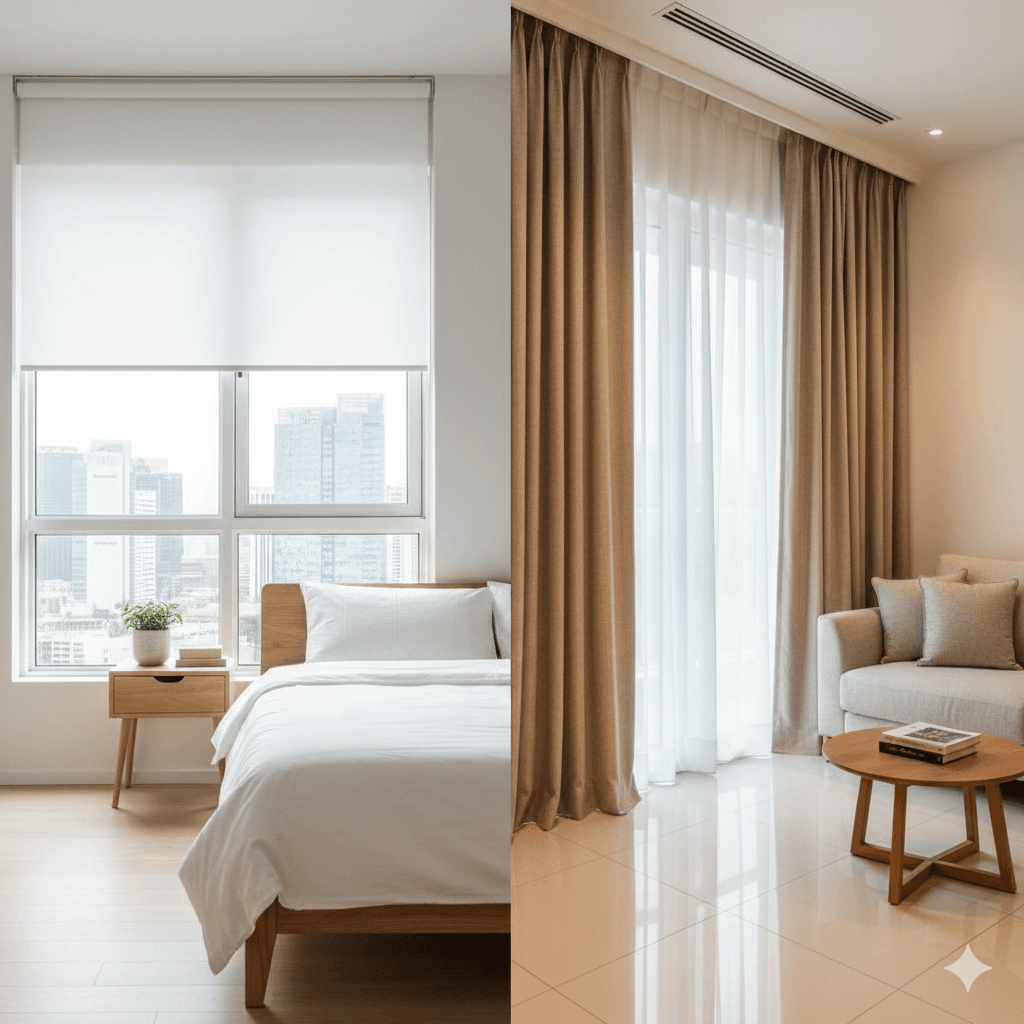
One of the most common questions we receive from homeowners is whether to choose roller blinds or curtains for their Singapore homes. Both options have distinct advantages and trade-offs, and the right choice often depends on your specific needs, room function, and lifestyle. Let's break down the key differences to help you make an informed decision.
Functionality and Light Control
Roller blinds offer precise, adjustable light control that curtains simply can't match. With a simple pull or motor control, you can position the blind at any height, allowing you to block harsh afternoon sun while still letting in light from the top of the window. This granular control is particularly valuable in Singapore, where the sun's position and intensity change dramatically throughout the day. Blackout roller blinds provide complete darkness when fully lowered, making them excellent for bedrooms and home theatres.
Curtains, on the other hand, operate on an all-or-nothing basis for the most part. While you can tie them back or leave them partially drawn, they don't offer the same precise control. However, curtains excel at diffusing light when made from sheer or semi-sheer fabrics, creating a soft, ambient glow that many find more aesthetically pleasing than the stark on-off nature of blinds. Layering sheer and blackout curtains gives you flexibility, though at a higher cost and with more bulk.
Maintenance and Durability in Humid Conditions
Singapore's high humidity is a crucial factor in this comparison. Roller blinds, especially those made from PVC, polyester, or treated fabrics, are inherently more resistant to moisture and mould. They're easy to wipe down with a damp cloth and don't trap humidity the way thick curtain fabrics can. The mechanism, if properly installed and made from quality materials, can last 5-10 years with minimal maintenance. However, cheaper roller blinds may suffer from mechanism failure, warping, or fabric degradation within 2-3 years.
Curtains require more maintenance in Singapore's climate. They trap dust, absorb cooking odours from open-concept kitchens, and can develop musty smells if humidity is high and air circulation is poor. Most curtains need professional cleaning every 6-12 months, which adds to the long-term cost. However, quality curtains made from moisture-resistant, treated fabrics can last 7-10 years or more, potentially outlasting roller blinds if well-maintained.
Cost Comparison
Initial costs vary significantly based on quality and customisation. Basic roller blinds typically start from $80-150 per window for standard sizes, while custom options range from $200-500+ depending on fabric, size, and mechanism quality. Curtains are generally more expensive upfront, with custom-made options starting from $300-600 per window including fabric, lining, and installation. However, ready-made curtains can be found for $30-120 per panel for standard sizes.
Long-term costs also differ. Roller blinds have minimal maintenance costs but may need complete replacement if the mechanism fails. Curtains have ongoing cleaning costs ($15-40 per panel for professional cleaning) but can be repaired or refreshed rather than fully replaced. For a typical 4-room HDB flat with 5-6 windows, expect to spend $1,500-3,000 for quality roller blinds or $2,500-4,500 for custom curtains throughout the home.
Room-Specific Recommendations
For bedrooms, blackout roller blinds are hard to beat for pure functionality. They provide complete darkness, take up minimal space, and are easy to operate even in small rooms where curtains might feel bulky. However, curtains add warmth and softness that many people prefer in a bedroom environment. Consider your priorities: if sleep quality is paramount, roller blinds win. If ambiance matters more, curtains are worth the trade-off.
Living rooms and dining areas generally benefit from curtains, which add texture, colour, and a sense of luxury that roller blinds can't replicate. The flowing fabric softens the hard edges of modern HDB architecture and provides better sound absorption. However, if you have a minimalist design aesthetic or limited space, sleek roller blinds may suit your style better.
For kitchens and bathrooms, roller blinds are the clear winner. Their moisture resistance, easy cleaning, and compact design make them ideal for these high-humidity, functional spaces. Curtains in kitchens quickly absorb cooking smells and grease, while bathroom curtains risk mould growth despite ventilation.
The Verdict
There's no universal answer, but here's a practical approach: use roller blinds in bedrooms, kitchens, and bathrooms for functionality and easy maintenance. Use curtains in living areas where aesthetics and ambiance matter most. If budget allows, consider combining both: sheer curtains for softness with roller blinds behind for light control and privacy. This layered approach gives you the best of both worlds, though it requires more window space depth (at least 15cm clearance).
Related Posts
Need Help Choosing?
Our expert team is ready to help you find the perfect curtains or blinds for your Singapore home. Get a free consultation and quote today.
Get a Free Quote